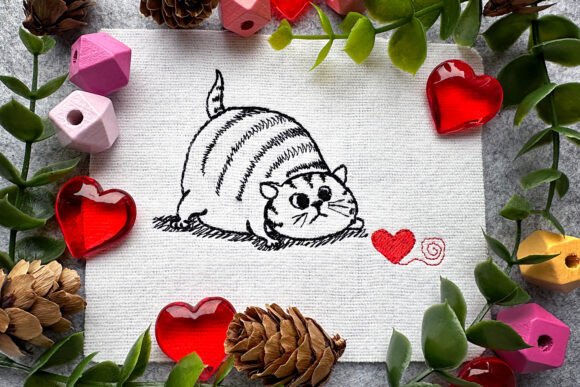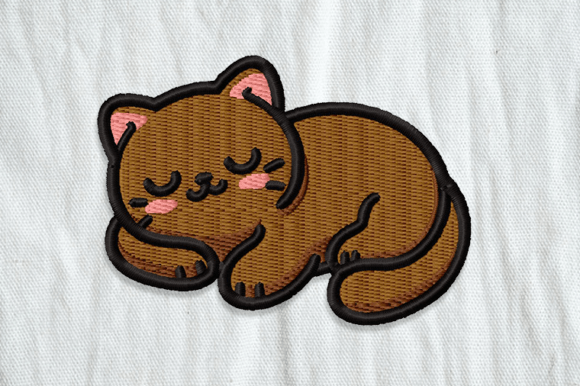
Sleeping Cat Embroidery Patch
First Impression: Warm, Approachable, and Brand-Ready
As an embroidery designer who’s developed hundreds of patches for small businesses—from neighborhood bakeries to indie pet boutiques—I immediately recognize the quiet strength in the Sleeping Cat Embroidery Patch. It doesn’t shout. It invites. The description—“a cute cat curled up in a peaceful slumber”—signals warmth, comfort, and gentle personality. That’s gold for brands building emotional connection. This isn’t just a decorative motif; it’s a brand tone setter. For cafés offering “slow coffee,” florists with cottage-core aesthetics, or handmade studios emphasizing care and craft, the Sleeping Cat Embroidery Patch reads as friendly, handmade, and quietly premium—not childish, not kitschy, and never generic.
Real-World Business Applications: Where It Shines
In my studio, I test every machine embroidery design across five real production scenarios before recommending it to clients. The Sleeping Cat Embroidery Patch excels in these high-impact uses:
- Staff aprons and uniforms: Its compact silhouette and soft curves translate beautifully onto cotton twill and denim—no distortion, no thread piling. Paired with a subtle business name (e.g., “Hearth & Honey Bakery” in clean sans-serif), it adds charm without clutter.
- Cap embroidery: At 2.5–3 inches wide, the sleeping pose holds shape on curved fronts. Unlike upright cats or complex poses, this design avoids stretching distortion at the crown seam.
- Tote bag design: Centered on natural canvas or unbleached cotton, it becomes a tactile signature—especially when stitched with matte cotton thread for organic texture.
- Branded product packaging accents: Sewn onto linen gift tags, reusable produce bags, or ceramic jar sleeves, it reinforces handmade authenticity.
- Etsy branding and customer gifts: As a sew-on patch included with orders (“Free patch with every $50 purchase!”), it boosts perceived value and encourages social sharing.
Careful Use Zones: Design Intelligence Matters
Even charming designs have boundaries—and overlooking them risks inconsistent finished product quality. Here’s where to pause with the Sleeping Cat Embroidery Patch:
- Under 2 inches: Fine details like ear contour or paw curl may blur. Always run a test stitch-out at your target patch size—especially for cap backs or sleeve accents.
- Dark or textured fabric: Heavy terry cloth, corduroy, or black performance polyester can mute thread contrast. Confirm thread colors hold depth—navy or charcoal gray on black fabric often reads richer than pure black.
- Frequent-wash items: If used on café server aprons or daycare staff uniforms, verify stitch density supports durability. Overly dense fills trap moisture; too-light outlines fray. A balanced fill-and-outline balance is essential for commercial embroidery longevity.
- Curved surfaces beyond caps: Avoid placing near gussets or seams on structured tote bags unless you’ve tested stabilizer pairing—cutaway + tear-away combo prevents puckering.
Brand Identity Impact: More Than Just a Cat
A single embroidered patch can elevate how customers perceive your entire operation. The Sleeping Cat Embroidery Patch subtly communicates care, consistency, and intentionality—traits that build trust far faster than text alone. When sewn onto a florist’s linen smock or a pet brand’s organic cotton bandana, it signals alignment with values: calm, presence, craftsmanship. It also strengthens visual consistency across touchpoints: same patch on staff caps, tote bags, and online product mockups creates cohesive recognition. For Etsy sellers, that consistency increases repeat buyer confidence—and reduces returns due to “not what I expected.” Crucially, its simplicity makes it scale-friendly: it works beside minimalist logos, vintage typography, or botanical watercolor prints without competing.
Practical Embroidery Designer Notes
Before cutting fabric or sending files to your digitizer, follow these field-tested steps:
- Test in black and white first: Print a grayscale version to assess value contrast—critical for readability on dark uniforms or busy fabrics.
- Verify small-size legibility: Resize your digital embroidery file to 1.75” and check if the cat’s outline remains clean—not jagged or fused.
- Review thread color contrast: Swatch actual threads on your base fabric. A warm taupe cat on oatmeal canvas reads differently than on heather grey.
- Inspect spacing and underlay: Tight curves (like the tail curl) need proper underlay to prevent gaps. Ask your digitizer about pull compensation.
- Confirm hoop size compatibility: Ensure your standard hoops (e.g., 4x4 or 5x7) accommodate the design without re-hooping mid-stitch.
- Test on real fabric + stabilizer: Run a sample on your exact apron twill or cap twill—not just practice muslin.
- Create a printable mockup for client approval: Show the Sleeping Cat Embroidery Patch on a realistic cap or tote render—not just a flat JPEG.
- Compare beside other design assets: Does it harmonize with your logo, typography, and color palette—or clash in weight or energy?
- Confirm commercial licensing: If sourcing from a marketplace, double-check usage rights for small business merch, resale, and unlimited production runs.
Final Thought: A Strategic Stitch, Not Just a Cute One
The Sleeping Cat Embroidery Patch isn’t merely “adorable”—it’s a functional, emotionally intelligent tool for small business branding. In a market saturated with loud logos and disposable graphics, its quiet confidence stands out. Whether anchoring a boutique’s identity or softening the edges of a tech-adjacent creative studio, it delivers cohesion, warmth, and professionalism—all in one compact, stitch-ready form. For embroidery shops and apparel decorators, it’s a reliable, versatile asset—one that earns its place on aprons, caps, totes, and beyond. Just remember: great custom apparel starts with intentional design choices. Test it. Refine it. Then let that sleeping cat do the work—calmly, consistently, and unmistakably yours.