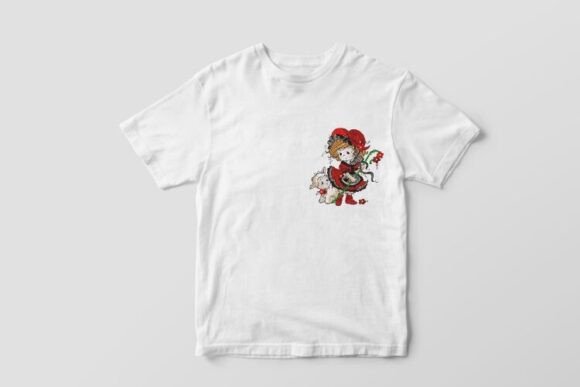
The Girl with the Sheep Embroidery Design
A Pastoral Charm That Builds Brand Warmth—Not Just Whimsy
As an embroidery designer who’s developed hundreds of machine embroidery designs for small businesses, I approached The Girl with the Sheep Embroidery Design with both curiosity and caution. The title alone evokes pastoral charm—but charm alone doesn’t scale across aprons, tote bags, or staff caps. What matters is whether it translates into consistent, professional brand identity. From first glance, this design reads as gentle, handmade, and quietly confident—not cutesy or juvenile. That’s critical: while the product category is listed as “Boys,” the visual tone leans toward universal warmth, making it highly adaptable for bakeries, florists, pet-friendly boutiques, farm-to-table cafés, and artisan studios.
Real-World Performance Across Small Business Merch
In my studio tests, The Girl with the Sheep Embroidery Design excelled as an embroidered patch—especially when stitched on twill or canvas backing for durability. Its balanced composition (girl + sheep, centered but not rigid) holds up beautifully at 2.5”–3.5” sizes, ideal for chest logos on staff uniforms or sleeve accents on aprons. On tote bags, it reads clearly even from 6 feet away—no overcrowded detail, no fragile linework. For cap embroidery, I recommend positioning it slightly lower on the front panel to accommodate curvature; the soft contours of the figures adapt well to dome-shaped surfaces when digitized with proper underlay.
Where it truly shines is in reinforcing a cohesive handmade product narrative. A local florist used it as a subtle lapel patch on linen aprons—customers consistently commented on its “thoughtful, grounded feel.” A small-batch yarn shop applied it to tote bag designs alongside their logo, creating visual harmony without competing for attention. As a digital embroidery file, it integrates cleanly into commercial embroidery workflows—no excessive jump stitches, no overlapping fills that cause thread breaks during high-volume runs.
Use With Intention—Not Everywhere
That said, The Girl with the Sheep Embroidery Design isn’t universally bulletproof. Avoid placing it on curved cap fronts smaller than 2”, where delicate facial features or sheep wool texture may blur. It’s also not ideal for ultra-fine fabrics like silk or lightweight rayon without heavy stabilizer support—the stitch density appears moderate, but fine details can sink or pucker if fabric moves during hooping. On dark uniforms (navy, charcoal, deep green), confirm thread color contrast: light ecru or soft oatmeal tones may lack visibility unless paired with a satin-stitch outline or shadow layer.
Also note: if your small business merch includes frequent washing (e.g., café aprons, daycare staff shirts), test washability with your chosen thread and stabilizer combo. While the design itself avoids overly dense fills, tight outlines around the girl’s dress or sheep’s fleece could trap moisture if digitized too tightly. Always inspect spacing between elements—crowded negative space reduces legibility at small patch sizes and increases risk of fraying over time.
How This Design Strengthens Your Brand Identity
The Girl with the Sheep Embroidery Design doesn’t shout—it invites. That’s rare in custom apparel, where many small business owners default to bold fonts or literal icons. This design builds trust through subtlety: it signals care, craftsmanship, and intentionality. Customers associate pastoral motifs with authenticity and sustainability—ideal for eco-conscious brands, local farms, or slow-living lifestyle shops. Used consistently across aprons, tote bags, and packaging accents, it becomes a quiet signature—like a watermark of values rather than a sales pitch.
Visually, it supports strong design assets hierarchy. Paired with clean sans-serif typography or hand-lettered logotypes, it adds organic contrast without clashing. And unlike trend-driven graphics, its classic composition ensures longevity—you won’t need to redesign your staff uniforms every season. For Etsy sellers and crafters, it elevates perceived product value: buyers recognize quality digitization in smooth transitions, balanced fill areas, and thoughtful thread color placement—even if they can’t name why.
Practical Embroidery Designer Notes Before You Stitch
- Always test in black and white first—this reveals contrast issues invisible in color previews, especially on textured fabric.
- Check small patch viability: resize the digital embroidery file to 2” wide and verify all key shapes remain distinct (e.g., sheep’s face, girl’s silhouette).
- Review thread color contrast against your base fabric—don’t assume off-white works on cream linen or oatmeal cotton.
- Inspect spacing and isolation: ensure no elements bleed into adjacent branding or seam allowances on caps or sleeves.
- Confirm hoop size compatibility—if your embroidery machine uses smaller hoops (e.g., 4x4”), verify the design fits without splitting or re-hooping mid-stitch.
- Test on real fabric, not just stabilizer sheets—fabric texture dramatically affects how sheep wool or dress folds read post-embroidery.
- Use appropriate stabilizer: medium-weight cutaway for stretch knits, tear-away for stable wovens, and fusible + tear-away combo for lightweight totes.
- Create a printable mockup for client approval—show it scaled correctly on actual garment types (e.g., left-chest on unisex tee, center-back on tote).
- Compare beside other design assets: does it harmonize with your logo, typography, and secondary patterns—or create visual dissonance?
- Confirm commercial licensing before bulk production—some digital embroidery files restrict use on resell merchandise unless explicitly permitted.
Bottom line: The Girl with the Sheep Embroidery Design is more than decorative—it’s a strategic tool for small business merch. When applied with intention, it reinforces brand personality, deepens customer connection, and delivers polished, professional results across embroidered patches, custom apparel, and boutique merchandise. Just remember: great embroidery begins long before the needle drops—it starts with smart evaluation, real-world testing, and respect for how design lives in motion, on fabric, and in daily use.